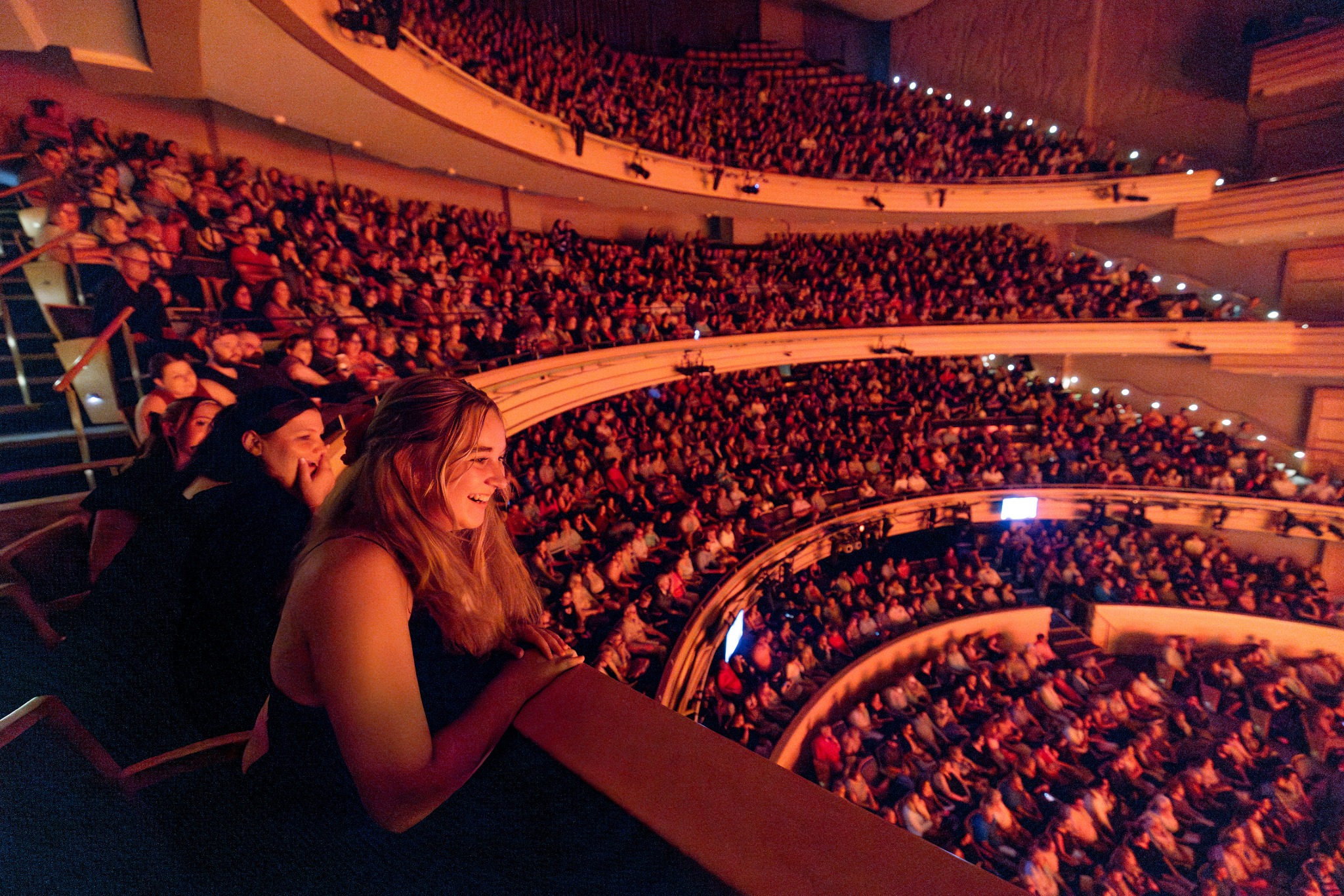
No Longer Forced to Choose: Madison's Overture Center and Deaf Accessibility
For many, entering a theater is an all-encompassing, sensory overload experience. The shuffle of feet as guests take their seats, the swell of strings as the orchestra begins, and the roaring applause at the end of a performance. But for those who live in a world without sound, the experience is quite different.
They experience the performance through, and by, the interpreters, when and wherever they’re offered. And often, they’re forced to choose: access to language or access to the artistic storytelling happening on stage. But with a few small changes, the Overture Center for the Arts in Madison has changed that.
Thomas Klubertanz, Director of Guest Services at the Overture, has worked alongside his team to expand accessibility for disabled communities. In his eight years with Overture, they’ve finetuned services, surveyed for feedback, made changes and opened previously closed doors for thousands of Deaf theater lovers.
In recent years, the Overture has partnered with Accessible Concerts & Theater (ACT) Interpreting, which specializes in training American Sign Language (ASL) interpreters for theater and concert performances.
About 500,000 Deaf or hard-of-hearing individuals use ASL in the United States, according to the National Census of the Deaf Population. The Registry of Interpreters for the Deaf reports there are around 10,000 certified ASL interpreters in the nation. That means there is roughly one interpreter for every 50 individuals who rely on their services.
Partnerships like the one between ACT Interpreting and the Overture help bridge that gap, giving Deaf audience members the opportunity to enjoy theater in ways they couldn’t before.
“We talk about extraordinary experiences for all people. But when you say some blanket statement, like ‘for all people’ or ‘for all’ then you really have to back that up,” Klubertanz said. And so, they turned to ACT Interpreting.
Leigh Whisenant, ACT Founder, Interpreter and Coordinator, said the approach to translating English into ASL is a specialized practice. In performance interpreting, it’s not enough to translate English word-for-word into ASL. Instead, they must evaluate the nuances, the metaphors and what the characters are really saying.
Additionally, Whisenant brings in Directors of Artistic Sign Language; Deaf professionals who work alongside interpreters to shape the translation of the script and ensure the story’s meaning is conveyed to the audience.
“I rely on the [Deaf] community as well, to tell me with guidance, to tell me what’s working, what’s not,” Whisenant said, “It’s always been community-based. It’s always backed by the community.”
And it goes beyond just the translation. A change as simple as where the interpreters are located has made all the difference for Deaf audience members. Before, they had their head on a swivel, missing pieces of the performance while they look to the interpreter for context. But now, Overture interpreters are intentionally positioned directly in their line of sight. This adjustment transforms the performance from a disarticulate puzzle for Deaf attendees to put together, into a fully immersive, emotional experience.
“Something that might seem so little to you, could just be opening doors for somebody else out there that are so massive and incomprehensible, that it really becomes a pretty powerful thing,” Klubernatz said.
Before prioritizing accessibility, the Overture rarely saw Deaf audience members in attendance. Even while meeting the standards of the Americans with Disabilities Act (ADA), the organization realized there was more to accessibility that simply checking the boxes.
Alexis O’Connell, Manager of Guest Services, said leadership took the initiative to go further.
“The reason why we’re doing all of this work is because I think we fundamentally believe at the core of our existence that every single person deserves access to the arts,” O’Connell said.
For staff at Overture, and ACT Interpreting, the first step is always to connect with the communities they’re serving. Listening, being open to feedback and stepping up to make real changes is their philosophy. And it’s powerful. Klubernatz said the Overture sold its first three season subscriptions to Deaf patrons this year, marking a first for the organization.
“We know the power of the arts. We’ve all been shaped and molded and influenced in a million different really great ways. And so, we know how important the arts are for community,” Klubertanz said, “There is a benefit to everybody in our community when we make our world a more accessible place.”
Post a comment