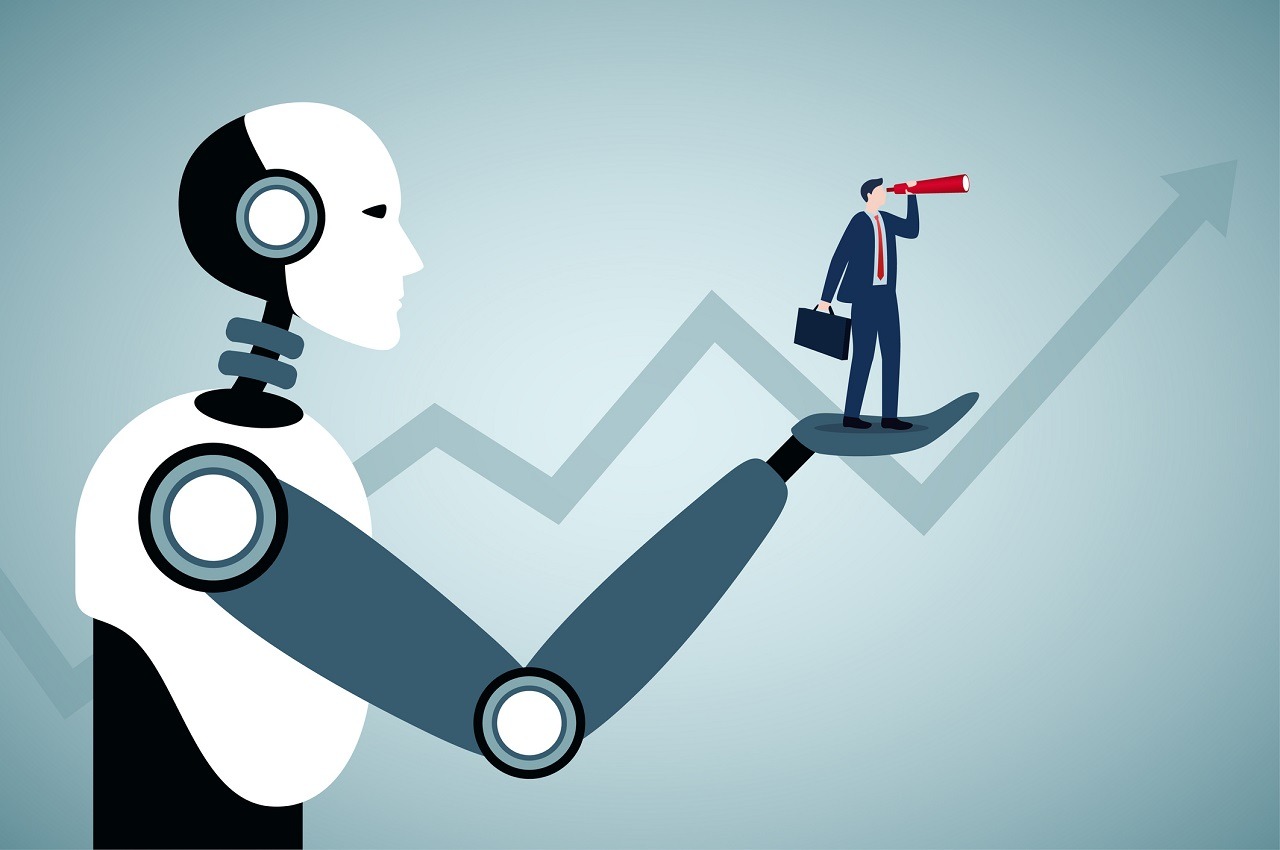
AI in the Hands of Future Professionals
Around the world, professionals clutch their briefcases, stethoscopes and notebooks tight, protecting them from the grasps of artificial intelligence (AI). Yet budding professionals just beginning to master their field don’t view AI as an enemy. Instead, they see it as a helping hand, and one that they can easily swat away if needed.
For college students at the University of Wisconsin-Madison, classes across campus are teaching them what it means to use AI as a tool. They use it to work more efficiently, check if their work has met rubric requirements and become a force of the future. To them, AI is something to work around, not against.
Pre-nursing student, Olivia Sutor, uses AI to help her memorize medical terms and concepts for her undergraduate exams. By putting her notes and lecture slides into an AI tool called NotebookLM, Sutor can use the AI-made practice exams, concept maps and studying methods to prepare her for midterm exams.
“I’ve used that in physiology, I’ve used that in anatomy, and in microbio, and it’s significantly improved my exam scores,” Sutor said.
According to a comprehensive literature search by the National Library of Medicine, AI is being used to assist nurses with regulatory paperwork, saving 25% of time spent during their shift. And while Sutor uses it in her studies regularly, she never fears AI overtaking her future career in nursing.
“In almost all of my classes we focus on trust and connection so that people feel safe enough to talk to us about what’s going on with them,” Sutor said, “Without human connection, we’d be losing the essence of what healthcare is.”
Also in the healthcare field, Stella Delcore is earning her degree in kinesiology before going to physical therapy school. In her classes, AI can be used to complete more substantial aspects of her work. One of her recent school assignments was to complete a training plan for a fictional athlete competing in a HYROX competition. After finishing the assignment, her professor plugged the same prompt into an AI tool, and the class watched as AI wrote up an almost identical plan.
“It obviously doesn’t understand the chemistry and physiology behind it’s work, but it’s interesting to see what AI can do as well as us, and what it can’t,” Delcore said.
For future healthcare providers, the threat that AI poses is slim. To them, the humanity behind their work is what will win out every time. But what about those who have futures in offices and not hospitals?
Samantha Holle, a journalism student and aspiring marketer, has found a way to work AI into her semester curriculum. AI in Strategic Communications is a recent addition to the UW-Madison’s School of Journalism and Mass Communication. But a necessary one.
“I see it as a way to make my life more efficient in my job, not necessarily taking away from what I can do personally, but adding on,” Holle said, “There’s always an aspect of human oversight and there’s always ways that the AI lacks in its response.”
And while they’re separated by majors, another student at UW-Madison shares a similar perspective on AI in communication fields. Studying communication arts and entrepreneurship, Tessa Doszak relates the use of AI in her field to the common phrase: ‘Keep your friends close, and your enemies closer.’
Doszak hopes of entering the world of marketing after graduation. While many companies are using AI to generate their commercials or marketing campaigns, Doszak and many other consumers share an aversion to this decision. In 2025, Coca-Cola used an entirely AI-generated ad for their holiday campaign, sparking huge backlash from consumers. It’s fallouts like these that keeps the human mind at the forefront of creative fields.
“To me using AI to create those campaigns reduces creativity,” Doszak said, “It makes the process of campaign cultivation seem cheap and unimportant.”
So, while 62% of Americans say they use AI in their daily lives, there are certain aspects of the world that it just can’t live up to. A comforting smile from a doctor or a never-before-seen pitch idea for a film. No matter how hard it tries, AI will never be human.
“Nothing will ever be able to replace human art, or the human mind,” Doszak said.
Post a comment